HEALPix#
HEALPix (Hierarchical Equal-Area isoLatitude Pixelisation) was originally defined for use in astronomy by Gorski et al., 2005. It has several important properties:
equal-area: all cells of the same refinement level have exactly the same area
iso-latitude: all cells of the same refinement level are arranged around rings of the same latitude
hierarchical: cells are created by recursively and evenly subdividing, which forms a hierarchy of cells
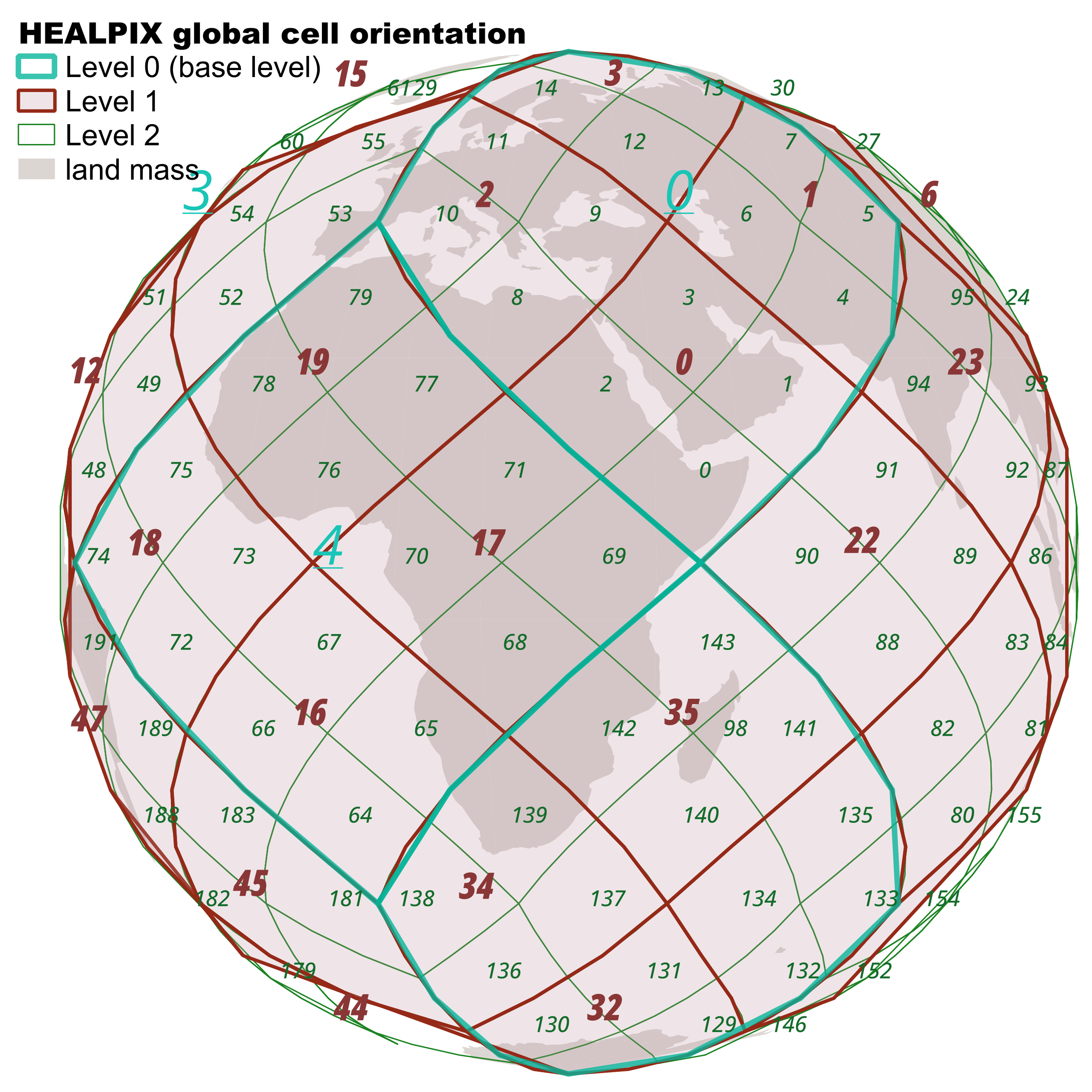
The nested indexing scheme of HEALPix#
The latter two properties allow defining the two main indexing schemes:
ring, which assigns identifiers along the iso-latitude rings. Thus, cells on the same latitude ring have identifiers that are “close” numerically (and thus in memory for sorted data).nested, which assigns identifiers such that sibling cells are close to each other.
To know what cell a identifier refers to, we need two additional parameters: the refinement level (the depth in the hierarchy) and the indexing scheme.
Based on nested, there are two more schemes that also encode the refinement level in the cell id:
nuniq, which represents all cells in the hierarchy breadth-first, i.e. cells of a refinement level are close numerically.zuniq, which represents all cells in the hierarchy depth-first, i.e. descendant cells of a given cell are close numerically.
Extensions#
HEALPix Extension to Ellipsoids: Apply HEALPix to ellipsoidal Earth models via an area-preserving mapping to an authalic sphere.