HEALPix Extension to Ellipsoids#
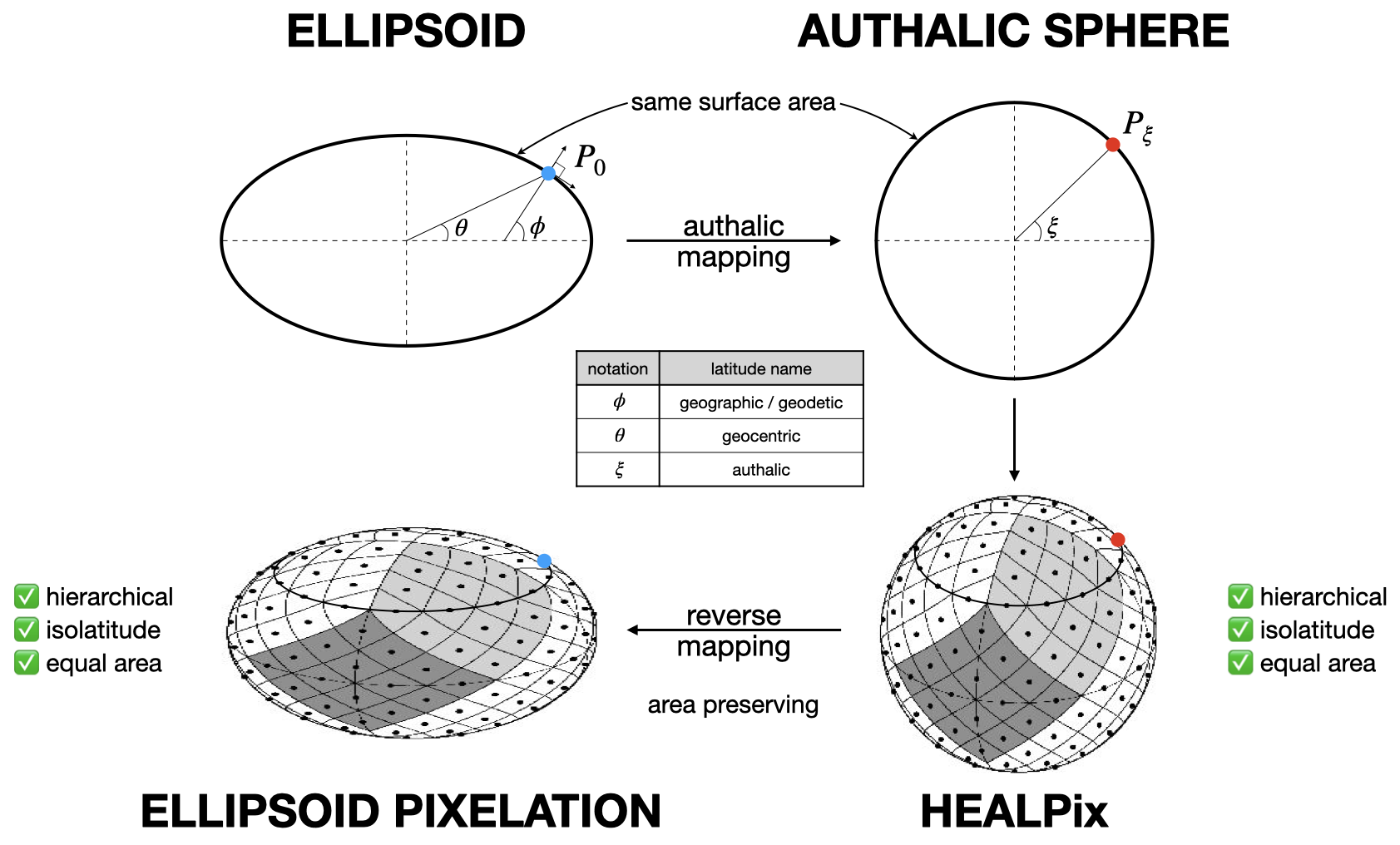
This page outlines an extension of the HEALPix pixelation scheme to ellipsoidal Earth models using an authalic transformation: a mapping to a sphere that preserves the surface area.
Ellipsoidal to Authalic Mapping#
Why Extend HEALPix?#
Standard HEALPix is defined on the sphere and provides:
Hierarchical structure
Isolatitude grid
Equal-area pixels
However, many geospatial applications require ellipsoidal models (e.g. WGS84). As a consequence, to be viable for these HEALPix needs to be mapped to ellipsoids of revolution.
How it works#
To maintain HEALPix’s properties on an ellipsoid, it is mapped to the ellipsoid’s authalic sphere (a sphere with the same surface area as the ellipsoid). The procedure is:
Authalic Mapping Geodetic latitudes (\(\phi\)) on the ellipsoid are mapped to authalic latitudes (\(\xi\)) on the sphere via an area-preserving transformation.
HEALPix on the Sphere Standard HEALPix is applied on the (authalic) sphere using latitude \(\xi\) and longitude \(\lambda\).
Optional Reverse Mapping Pixel centers or boundaries can be projected back to ellipsoidal coordinates if needed.
Authalic mappings:
Forward: \(\phi \to \xi\) (ellipsoid \(\to\) sphere)
Reverse: \(\xi \to \phi\) (sphere \(\to\) ellipsoid)
Ellipsoidal Pixelation#
This method results in a distorted HEALPix grid on the ellipsoid, preserving equal-area properties. It is ideal for satellite data, climate grids, and DGGS applications that need to account for Earth’s flattening.